Women’s Centers in Afghanistan
Background
More than two decades of protracted war, impoverishment, disintegration of the rule of law and systematic exclusion of women from social, economic and public life have severely impacted Afghans in general, but Afghan women in particular. Women, together with their children, account for approximately 65% of Afghan internally displaced persons (IDPs) and refugees. More than two million women are war widows and even larger numbers are de facto heads of households. The female illiteracy rate is 85% and maternal mortality rates are among the highest in the world.
Afghan women who have been left to deal with physical and psychological hardship as sole heads of household constitute one of the most vulnerable social groups in the country. Many women have lost contact with community networks, and traditional solidarity chains have been broken. Reports of violence against women are on the rise as women continue to be harassed, assaulted and raped as targets of ethnic reprisals in post-Taliban Afghanistan.
Although there are noticeable changes today in terms of women’s mobility and participation in community, many women still lack independent public spaces where they can come together as women.
|
"The plight of Afghan women and girls has been vividly demonstrated. Throughout the violence, Afghan women have maintained the desire to learn, to educate their children, to contribute to society. We can not sit idly by." – Sheryl J Swed, Immediate Past President, UNIFEM/USA |
UNIFEM Responds
As the only United Nations fund established specifically to support women, UNIFEM is working in Afghanistan to highlight gender equality and the active participation of women in the reconstruction efforts. UNIFEM has developed its strategy in consultation with Afghan women and in the context of the country’s history and culture.
In early 2002, UNIFEM established a program in Afghanistan to support the formidable challenge of bringing women and their perspectives into the mainstream of national reconstruction. An important focus of UNIFEM’s efforts has been working with the Ministry of Women’s Affairs (MOWA) to build its staff capacity and program to advance women’s rights.
With UNIFEM’s assistance, MOWA is addressing the challenge of reaching out to women in the provinces through the establishment of Women’s Development Centers (WDC). These Centers fulfill an urgent need for safe meeting places for women to discuss their priorities, gain access to social services and improve their education. At the Centers, local NGOs work together to provide a range of services including; health education, literacy classes, income and vocational skills training, legal and psychological support, childcare and computer training. Classes are offered in the constitutional and electoral process to ensure that women learn about their rights and participate in the political process. Executive Committees, drawn from local NGOs, clinics and schools, oversee the WDCs and work to enhance communication between woman’s groups, local authorities, provincial governors and MOWA.
|
"Progress for women in Afghanistan will mean progress for all citizens… Women’s status in Afghanistan should be the barometer of peace and security in the country.." – Noeleen Heyzer, Former UNIFEM Executive Director |

UNIFEM’s Center Successes
The Women’s Development and Community Centers’ initiative mobilizes women to secure their rights and seek sustainable livelihoods at the provincial and community levels. Currently, there are eleven fully functional Centers with accomplishments including:
- Providing trainings and services that have reached 5,685 women and girls, bringing the total number of beneficiaries to over twelve thousand since the first center opened.
- Expanding livelihood options for women through business skills development training, training in production for the market, micro-credit initiatives and market linkages facilitated by the Afghan Women’s Business Council.
- Raising understanding among women of human rights and key national processes of nation-building, reform and reconstruction through civic education outreach to women, and legal awareness projects run by professional women’s groups.
- Increasing access to legal aid and counseling through the services of professional associations of women’s lawyers as well as access to psychosocial counseling.
- Strengthening independent management structure of centers.
UNIFEM’s goals for the future include enhancing the management skills of the centers’ leadership and stakeholders, building capacity for more training and service provision, facilitating a support network among the provincial and community centers, and promoting their overall visibility. Despite the constraints of the current security situation, UNIFEM continues to pursue expansion possibilities. While the centers have made much progress, there remains a great need for ongoing support to ensure that these young institutions can take root and grow.
| "We profoundly appreciate UNIFEM”s very valuable support to the Ministry of Women’s Affairs and the women of Afghanistan.
– Habiba Sarabi, Minister of Women’s Affairs until Dec. 2004
|
A Glimpse into UNIFEM’s Centers
Parwan Women’s Development Center (Charikar City, Parwan)
The Parwan Women’s Development Center (WDC) is located in Charikar City, where UNIFEM rents a two-story building from the Red Crescent Society, located on the same plot. The centre is easily accessible to women in Charikar.
In 2004, the Parwan WDC offered shoe- and bag-making projects. This year, the center offered training in: Psychosocial Counseling; Computer and English Training; Literacy, Health Education and Rights-Awareness; Poultry and Hygiene Education; Patu Weaving, and Legal Aid and Counseling. UNIFEM also supported the Department of Women’s Affairs (DOWA) International Women’s Day celebrations, which brought together a great number of government, local and international development players.
Said Khail IDP Women’s Community Center (Said Khail, Parwan)
The Said Khail IDP Women’s Community Center (WCC) is located in a remote rural area approximately one hour from Charikar City. The structure that houses the center is privately owned, although UNIFEM contributes to the rent through the funding of various activities. The main partner involved in running the center is the Afghan Women’s Resource Center (AWRC), an Afghan women’s NGO that has trained women from the community to manage the center and collect information on women’s needs and required activities.
UNIFEM is currently funding the following activities at the Center: Psychosocial Counseling and Literacy, Health Education and Rights-Awareness. The Counseling Project is an innovative program that teaches women relaxation and problem-solving techniques. Women at the Center are enthusiastic about the project and it has increased the participants ability to cope with difficult domestic situations. The Literacy Project offers a small microfinance component through loans of US$20-50 per woman. Personal accounts of women have revealed that the money has been used, to purchase livestock, set up home bakeries, and more. To date, repayment has been so successful that repaid loans are being fed back into the fund to benefit other women who attend the center.
Ghorband IDP Women’s Community Center (Ghorband, Parwan)
This WCC is located in a very remote and poor area in the mountains of Parwan province. There are four rooms available, one of which houses a small kindergarten where the participants’ children spend time during their mothers’ lessons – a fundamental service in areas such as this.
In 2005, UNIFEM continued to support the Humanitarian and Development Centre for Afghan Women (HDCAW) to conduct a new course that includes Literacy (using the official Ministry of Education, Department of Literacy approved curriculum), Health Education and Rights-Awareness Training. The number of women beneficiaries has increased to 200 and regular field monitoring visits reveal that the classes are proceeding very well and the centre is vibrant, with women and girls extremely happy with the lessons and appreciative of the opportunity to spend time with their peers.
Kapisa IDP Women’s Community Center (Kohistan, Kapisa)
The Kapisa WCC is located in a small building deep inside the village of Kohistan. It is a clean, warm, and well kept area consisting of three rooms. The surrounding community is quite large, and many women are interested in coming to the center. This center also features a small kindergarten.
At the beginning of the year, approximately 120 women attended the center and participated in a literacy course run by the Afghan Women’s Resource Centre (AWRC) with funding from other donors. UNIFEM is now funding a variety of new activities in this center: Literacy, Health Education and Rights-Awareness, Poultry and Hygiene Education, and Legal Aid and Counseling. An innovative course offering women relaxation techniques brings women together and provides opportunities for informal interaction.
Ghazni Women’s Development Center (Ghazni City, Ghazni)
The large, eight-room Ghazni center shares the Department of Education compound. However UNIFEM rents a separate, clean and accessible building where the Center is housed.
Currently, UNIFEM funds the following activities in this center: Microfinance, Computer and English Training, Bag-Making, Legal Aid and Counselling, and Honey Production. The center is operating at full capacity. iI is very active and community awareness, appreciation and participation are very high. The success of this center illustrates its potential for expansion with more activities in the surrounding districts.
Kandahar Women’s Development Center (Kandahar City, Kandahar)
The Kandahar WDC is located in District 2 of Kandahar City and offers a computer room with seven computers purchased for the computer literacy course
With the help of a local NGO, UNIFEM is now running a Computer and English course in the center and with the assistance of Medica Mondiale, UNIFEM is supporting Legal Aid and Counseling. Microfinance activities are expected to begin in the near future.
Herat Women’s Development Center (Herat City, Herat)
The Herat WDC is located a new building about five kilometres outside of Herat City.
Today, numerous activities are in progress and with the assistance of a WDC Coordinator, resulting in the increased presence and appreciation of UNIFEM. UNIFEM is currently funding the following activities: Training in Agricultural Planting; Literacy, Glass Carving; and Computer and English Training. Microfinance activities are expected to begin very soon as well. In addition, through dialogue and encouragement with DOWA, a number of the UNIFEM Computer and English project beneficiaries are women living in the United Nations High Commissioner for Refugees shelter, who are now learning new skills for their advancement in the community.
"All by ourselves we have raised US$300 because we belong to the centre and have organized ourselves. We want to start a shoemaking business. Now UNIFEM with the NGOs is helping us with training and marketing so that we can make a profitable business. We have a small shop in town where we sell our products: ‘this is the first time ever that women can trade in Charikar. It was never allowed before.’" —The leader of a widows’ organization of 340 widows, many of whom are disabled and caring for four or more dependents, about her experience at the Women’s Development Center in Parwan.
UNIFEM Initiatives
Women’s Fair Days
The Women’s Fair Day initiative aims to bring local women producers together and assist in the process of community mobilization. The concept was piloted in Charikar City where women were given free access to tables to display their products at prices they set themselves. Fair Days are advertised through local radio and television announcements and through the UNAMA press mechanism. The Fair Days also provide opportunities for other organizations to disseminate information on topics relating to governance (elections, the constitution, the parliamentary process), health and micro-credit.
The events have attracted between 100 and 200 women, of which 20 to 30 brought products to sell. The idea of the fair is also new for the women, and many are enthusiastic participants. Additionally, UNIFEM plans to replicate the initiative of the Women’s Fair Day in other centers.
“I am a widow, I have five children. My husband was killed by the Taliban. Since my children are small, I go house-to-house to d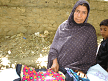 o laundry and get paid a wage. We are living ‘hand to mouth’ – just to survive. As soon as I heard through the radio about the Fair Day, I cancelled work today. I quickly collected the embroidery cloths which I kept for years in my wooden trunk with a wish that I could sell them. I told myself, if I could sell, I would buy a new sewing machine to make dresses for the neighbours. At night, I couldn’t sleep because of joy and I counted every hour to get near to the fair day. I thought I might never go to wash house to house again,†stated Fair Day initiative participant, Ashia. She continued “we didn’t have a space to gather in the past. In our village the women mostly should stay in four walls of their house, however, this space gives them a chance to be out for a while from their houses to enjoy themselves….and they become cleverer!†o laundry and get paid a wage. We are living ‘hand to mouth’ – just to survive. As soon as I heard through the radio about the Fair Day, I cancelled work today. I quickly collected the embroidery cloths which I kept for years in my wooden trunk with a wish that I could sell them. I told myself, if I could sell, I would buy a new sewing machine to make dresses for the neighbours. At night, I couldn’t sleep because of joy and I counted every hour to get near to the fair day. I thought I might never go to wash house to house again,†stated Fair Day initiative participant, Ashia. She continued “we didn’t have a space to gather in the past. In our village the women mostly should stay in four walls of their house, however, this space gives them a chance to be out for a while from their houses to enjoy themselves….and they become cleverer!†|
Local Tailoring Initiative
 UNIFEM is supporting a tailoring initiative in Kabul that builds on various efforts in recent years to train women in tailoring with a view to earning independent income. Working with a professional fashion designer from Italy, ten women and a project leader are producing a clothing line utilizing products available on the local market. The women will be involved, alongside UNIFEM staff, in the entire production process – from site management to resource location and raw material procurement, to managing marketing outlet relations. The target market for the products are the local “fashionable†Afghan women – a segment of the population that has access to disposable income, is interested in a modern look, but is currently obliged to purchase products imported from China, Pakistan and India, for lack of alternatives on the local market. UNIFEM’s aim is to play a supportive role throughout the whole process, providing women with the needed guidance and creative inputs, while putting them in the forefront of the interactions that will take place between themselves and consumers. Lessons from the project will also contribute to a deeper understanding of the potential for women’s entrepreneurial development.